An uncensored Chinese AI told me why ChatGPT recommends your competitor
~/blog/why-chatgpt-recommends-your-competitor.md
Last month I tried to get Claude to help me reverse engineer ChatGPT's search.
I wanted to know one thing: when a buyer asks ChatGPT about the exact problem my product solves, how does it decide who to recommend?
A quick disclaimer before we dive in: This Article is DENSE. I did my best to write it for human and AI readers. So if you're brain is fully rotted, feel free to copy the link, drop it in your coding agent, have it install the supereo mcp and say "get me recommended by AI".
All the research below is also coded into the supereo agents DNA. Just make an account, drop in your site, and it will get you recommended by AI when buyers ask about the problem you solve.
Alright, for anyone still reading LOCK IN twin.
The whole chain, from what it searches to why it names one company and skips the rest.
Claude was not having it.
It kept flagging my chats for "cyber." Every time I tried to go deeper, it pulled back.
I was trying to figure out how one chatbot picks winners, and the other chatbot decided I was a hacker.
So I went around it.
Enter deepseek-v4.1-flash-1017-xploded: an uncensored build of an open-weight Chinese model. Same DeepSeek you've heard of, minus the part where it says no.
It answered everything I threw at it, including the stuff Claude flagged. How ChatGPT rewrites a buyer's question before it searches, and why it often types your competitor's name into the search itself. Why Claude pulls from Brave's index instead of Google's, and what that does to who gets named.
There are a thousand threads on this app about getting ChatGPT to recommend your slop. Most say the same three things: write more content, get on Reddit, add schema.
Some of that works but most of it is outdated (reddit is now completely irrelevant for every engine besides google AI mode). How these engines pick is a black box and it changes every few weeks.
I wanted the inside of the box. I went deep. I built some hypothesis.
Then I started testing against real answers from six engines. Some of it held up, some of it was wrong, and some nobody's tested yet. I'll tell you which is which.
Here's how ChatGPT, Claude, Google and Perplexity each decide who gets recommended, and what to do so the next answer has your name in it.
There's no such thing as "AI search"
"Show up in AI" isn't one job. It's five or six jobs that barely overlap.
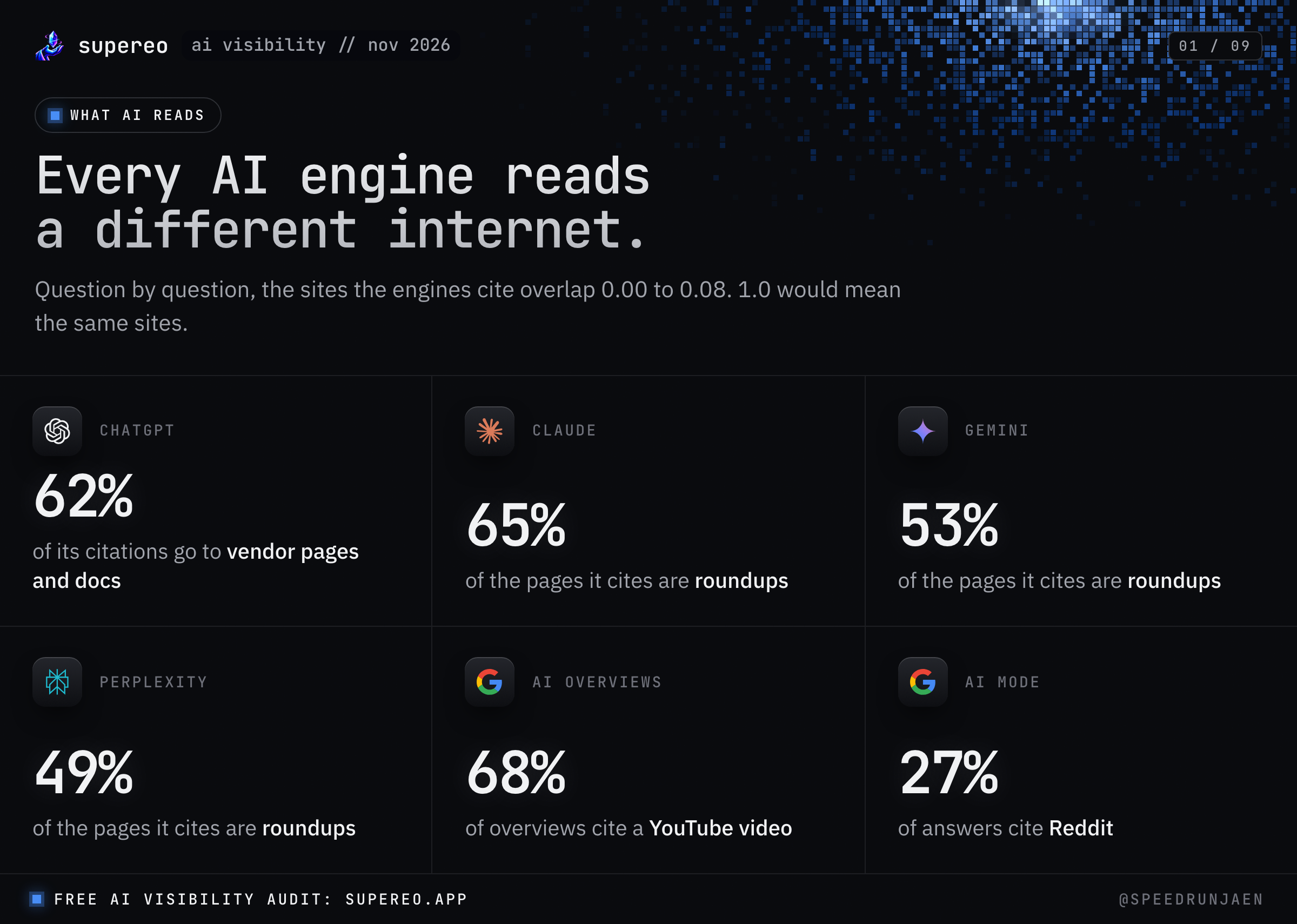
In one test, I ran 217 B2B buying questions through Claude, OpenAI's Codex, and Google's AI Overviews and AI Mode, then compared which websites each one cited. Question by question, the overlap between engines ran from 0.00 to 0.08, where 1.0 would mean they cite the exact same sites. They're basically reading different internets.
They don't agree on who wins, either. In one software category we track, six engines crowned four different #1s.
And each engine has a type:
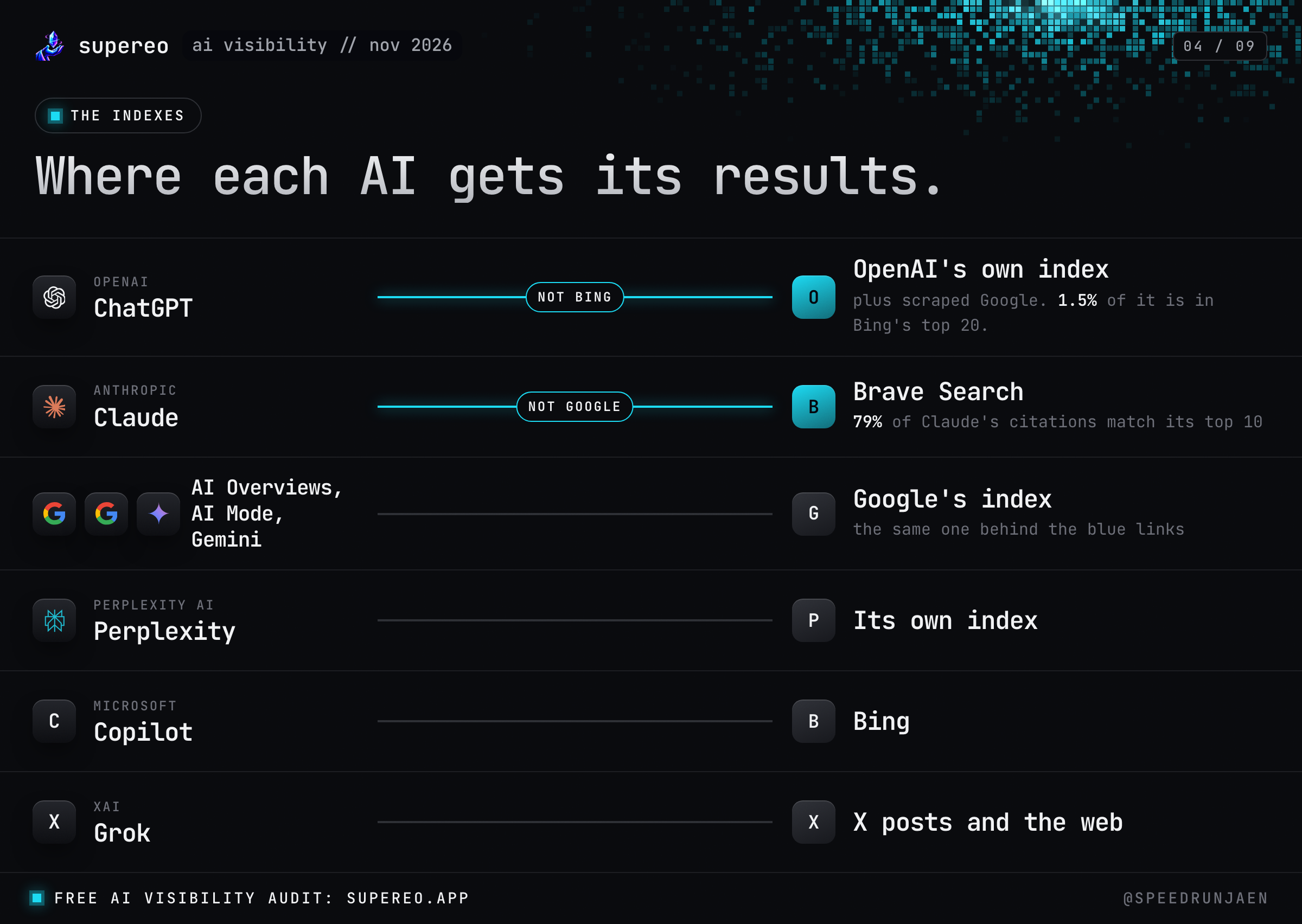
- ChatGPT sends 62% of its citations to vendor pages and docs, meaning the companies' own sites.
- Claude, Gemini and Perplexity lean on roundups, the "best X tools" articles. Roundups were 65% of the pages Claude cited.
- Google's AI Overviews cited a YouTube video in 68% of overviews.
- Google's AI Mode cited Reddit in 27% of its answers.
So the moves that get you into ChatGPT barely touch Google's AI, and the other way around.
That's why a single "AI visibility score" tells you nothing. supereo's free audit breaks it out engine by engine: how often each one recommends you, and who it picks instead.
How an AI answer gets made
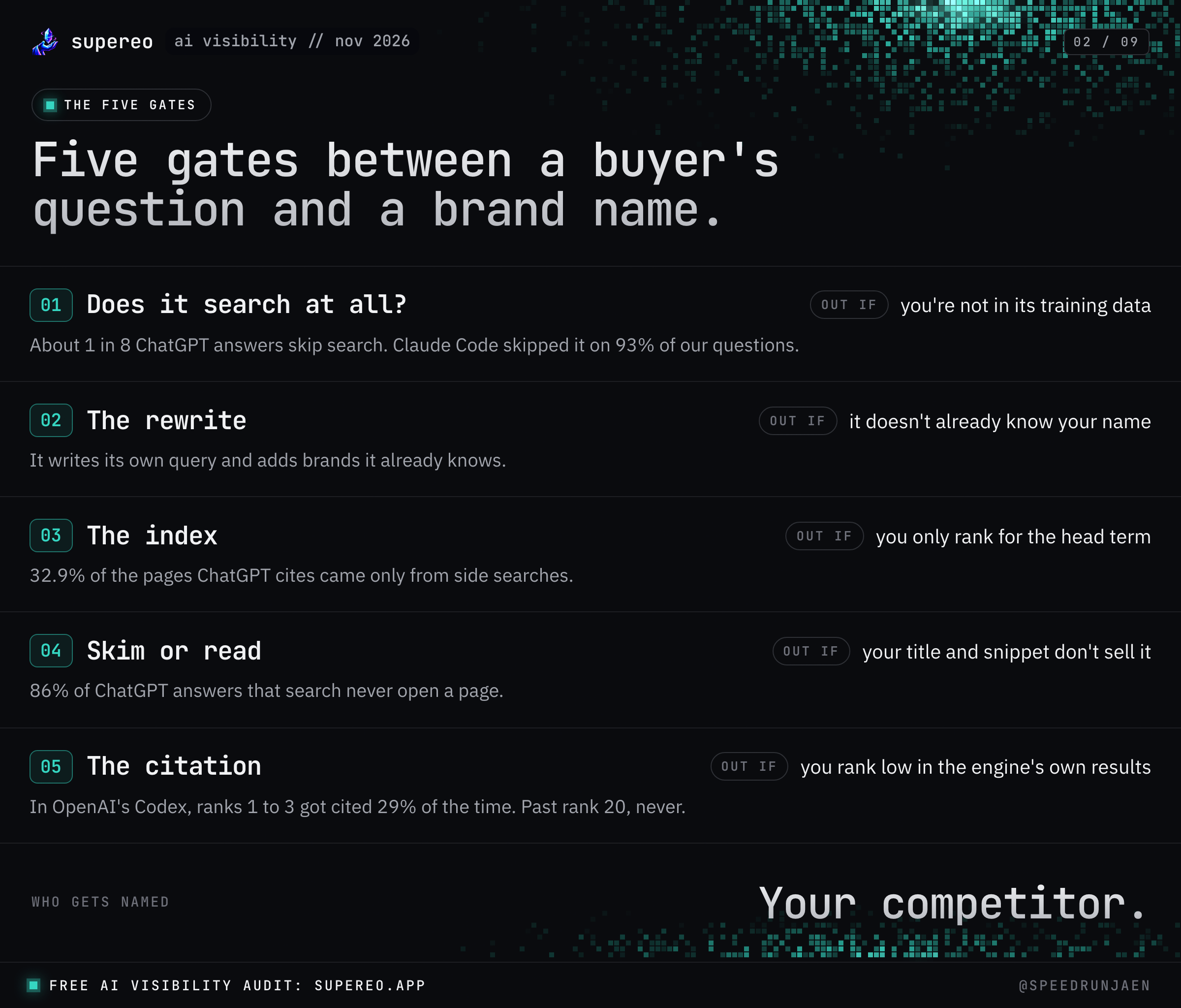
Every AI answer passes the same five gates. Your competitor made it through all five. You fell out at one of them.
Gate 1: does it search at all?
Less often than you'd think. Across 66.6 million free, logged-out ChatGPT responses, only about 1 in 7 triggered a web search. On the questions AI visibility trackers ask, it searches far more often, but roughly 1 answer in 8 still comes straight from memory. Claude Code answered 93% of our 217 questions without searching once.
No search means the answer comes from training data. Whatever the model soaked up about your category before its cutoff is what your buyer hears. If your competitor was all over the internet and you weren't, you lost before a single search ran.
Gate 2: the rewrite
When ChatGPT does search, it writes its own query, about 6.7 words long, and it often adds businesses it already knows.
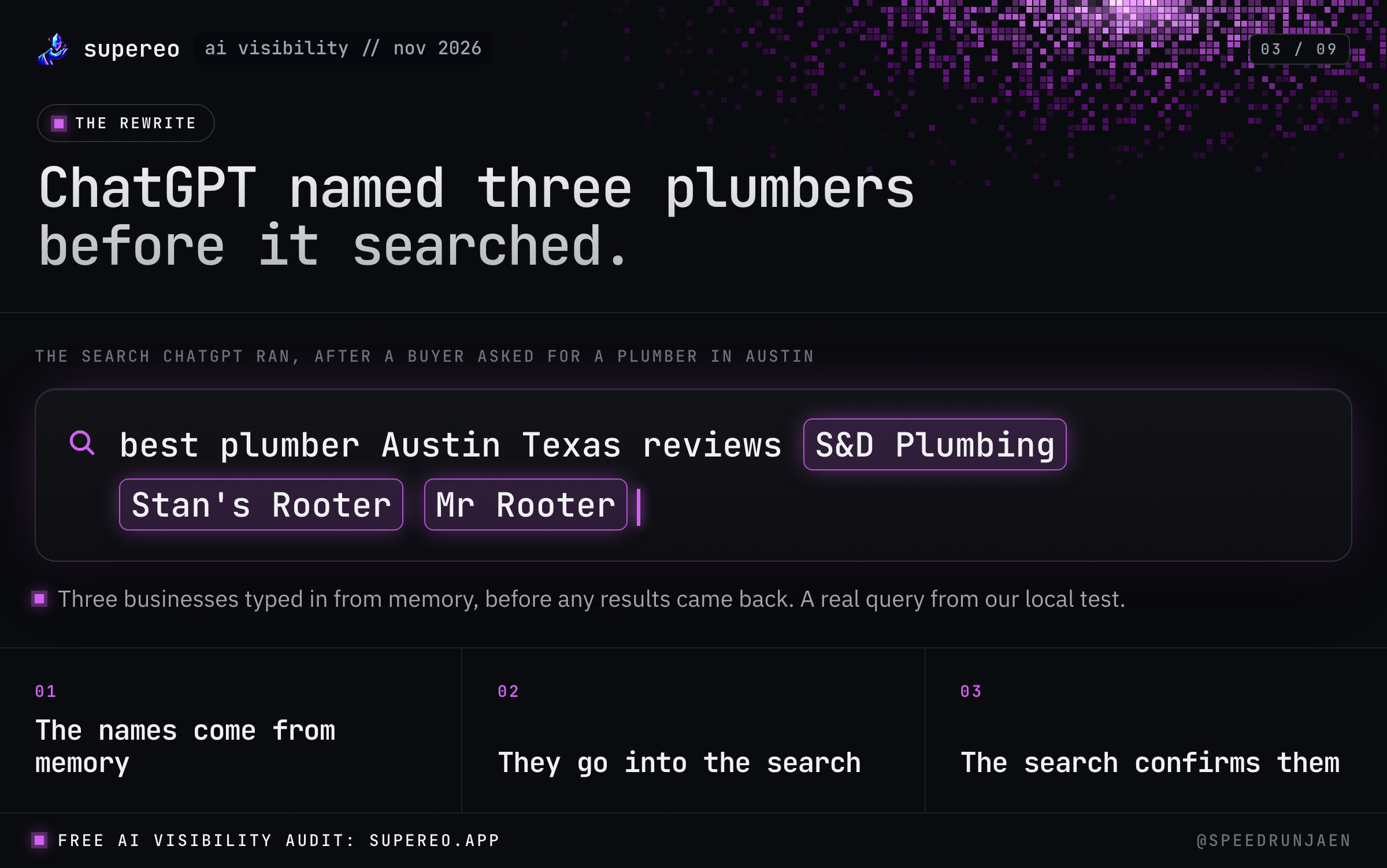
We watched it do this. Asked to find a plumber in Austin, it searched for:
"best plumber Austin Texas reviews S&D Plumbing Stan's Rooter Mr Rooter"
It named three plumbers before it saw a single result, then went looking for them.
I don't think people talk about this enough. A lot of the time, the search is there to confirm names the model already had in its head.
So the first thing to find out is whether the model has you in its head at all. Run the free audit and you'll know in about a minute, along with the competitor it reaches for instead.
Gate 3: the index
Each engine searches its own index, and it splits the question into side searches. In one study of 548,534 pages ChatGPT retrieved, 32.9% of the pages it ended up citing only showed up for one of those side searches, never for the original question.
So the head term is only part of it. You also need to rank for the searches the model runs behind your buyer's back.
Gate 4: skim or read
Mostly skim. In one capture of 1,249 ChatGPT answers that searched, about 86% never opened a single page. They picked straight from the search results, titles and snippets. Almost every page that did get opened came from the paid Thinking mode, so free users' answers basically never read your page.
That capture is from July, before OpenAI's October model update, so the exact number may have moved. The direction probably hasn't: your title and snippet do most of the selling.
Gate 5: the citation
Most of what gets pulled never gets cited. ChatGPT pulled Reddit threads into 29% of its search results and cited Reddit 1% of the time. OpenAI's coding agent, Codex, cited results at ranks 1 to 3 about 29% of the time, ranks 4 to 10 just 8%, and nothing past rank 20.
That's the engine's own ranking, and it's a different list from Google's. Only 12 to 26% of the domains Codex and Claude cite rank in Google's top 10.
None of this shows up in Search Console. supereo shows you the pages each engine cites for your buyers' questions, yours and your competitors', so you can see whose pages are doing the selling.
Why ChatGPT recommends your competitor
Put the gates together and you get the answer to the title. It's usually some mix of these six:
- They were already in its head. ChatGPT writes names it remembers into its own searches. If your competitor has years of reviews, comparisons and mentions floating around, the model reaches for them before it looks at anything.
- It left Bing. The old advice was to rank on Bing, because ChatGPT search ran on Bing. Now its results come from OpenAI's own index (it shows up in captured traffic as "labrador") plus scraped Google results, and only 1.5% of the URLs in that index sat in Bing's top 20. One crawler decides whether you can appear at all: OAI-SearchBot. Block it and you're out, and some CDN settings block it without asking you.
- The snippet is the whole pitch. Most searching answers never open a page, so your title and snippet have to sell it on their own.
- Vendor pages carry the citations. 62% of ChatGPT's citations went to vendor pages and docs, and 59% to the site of the brand it recommended. Your competitor's pricing page, docs and "X vs Y" page are doing the selling. If yours don't answer the buyer's question, you're not in the running.
- Listicles and Reddit are out. On "best X tools" questions, listicles fell to 1.2% of ChatGPT's citations by August. Reddit's share of its citations fell 86% that same month. Getting on a "top 10" list still helps on Claude and Google. On ChatGPT it barely registers.
- Freshness counts. Pages ChatGPT cited had been updated a median of 6 days earlier. Pages it read and dropped: 19 days.
This is also where DeepSeek got one wrong.
It told me ChatGPT over-cites Wikipedia, Forbes and Reddit. The Reddit part used to be true. Then August happened, and in our most recent head-to-head panel ChatGPT cited Reddit zero times. It cites the companies themselves now.
Uncensored doesn't mean up to date. It knew how ChatGPT used to work.
Which is the problem with every AEO guide, this one included: the engines change every few weeks. supereo tracks how often each one recommends you week over week, and flags it when a competitor starts getting picked over you.
Claude doesn't even use Google
Claude's web search runs on Brave.
Anthropic's own paperwork lists Brave as a web search subprocessor, and when about 35,000 Claude citations were checked against both engines, 79% matched Brave's top 10. Google's top 10: 34%.
Brave is the thing everyone is sleeping on. I'd bet most people doing "SEO for AI" have never checked a single Brave ranking.
Claude also skips search a lot. Claude Code answered 93% of our questions from memory, and Claude's API skipped search on 16.5% of answers even with search switched on. Being in the training data matters even more here than on ChatGPT.
When it does search, it barely reshuffles what Brave gives it, so your Brave rank is close to your Claude rank. And it loves roundups: 65% of the pages Claude cited were roundups, and it cited 81% of the listicles it pulled. This is where "get on the best-of lists" still pays off.
Brave is also a pain to get into. There's no Search Console, no error messages, and the submit form sits behind a proof-of-work check and a CAPTCHA. New pages show up slowly and you can't see why.
DeepSeek explained why, and this one checks out against Brave's own open-source browser code. Brave discovers pages partly through its Web Discovery Project, an opt-in feature in the Brave browser that reports pages its users visit. To protect privacy, Brave can't read a page's report until about 20 different opted-in users have visited it (it never publishes the exact number). A bare homepage is the exception: one visit does it. And when Brave double-checks a page, it drops anything that redirects, doesn't return a clean 200, or only renders with JavaScript.
The white-hat version: link your important pages from your homepage, keep every URL loading directly with no redirects, and server-render.
That's the slow way. I'm building a tool right now that gets any page indexed in Brave almost instantly, and supereo users get access to it first. If you want it the day it ships, get on supereo now.
One more from DeepSeek, and this one I haven't tested: when Claude opens your page, a second cleanup pass strips out whatever doesn't look like the answer before the model ever sees it, and that pass runs no JavaScript. If that's right, the fix is self-contained answer blocks: the question, then a complete answer that makes sense on its own.
Google's AI runs on YouTube and Reddit
Google's AI Overviews and AI Mode pull from the same index as the blue links. Google says you need nothing special beyond being indexed and eligible for a snippet.
What it doesn't say is how much comes from off page one. Only 17 to 38% of AI Overview citations rank in Google's top 10, depending on whose study you trust. The rest come from the side searches Google runs, same as ChatGPT.
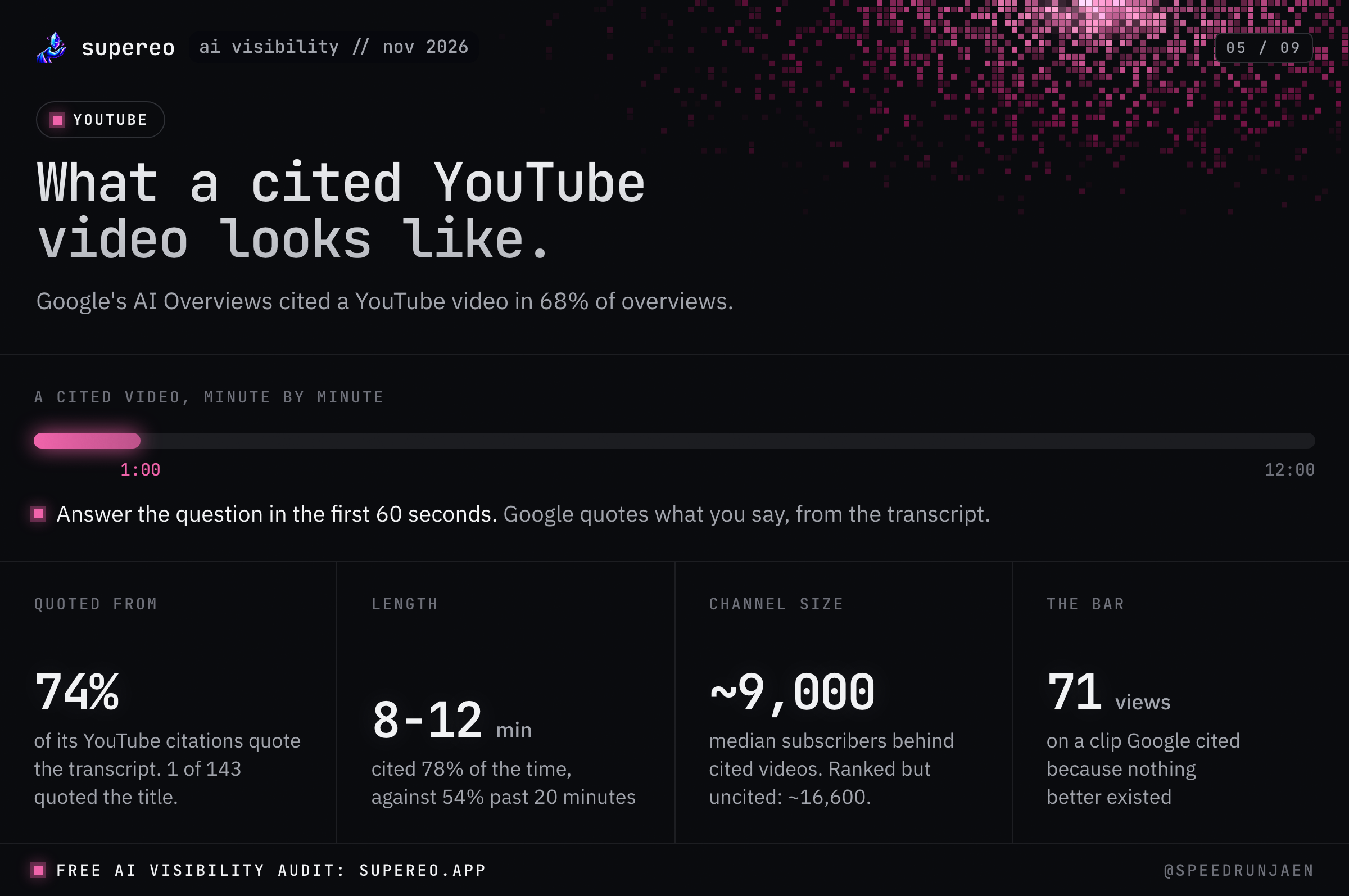
Then there's YouTube. AI Overviews cited a YouTube video in 68% of the overviews in our panel, and the videos that get cited follow a pattern:
- Google quotes what you say. 74% of its YouTube citations quoted the transcript, and 1 of 143 quoted the title.
- It quotes the start. Cited videos covered more of the question's words in their first 60 seconds, and most timestamped citations pointed into the first fifth of the video.
- 8 to 12 minutes is the sweet spot: cited 78% of the time, against 54% for videos over 20 minutes.
- You don't need a big channel. Cited videos came from channels with a median of about 9,000 subscribers, smaller than the ones that ranked and didn't get cited (about 16,600).
For a lot of questions there's no good video at all, so Google cites whatever's closest. We caught it citing a 71-view clip. If your buyer's question has no on-point video, this is the move.
Inside supereo, you can see which pages and videos Google's AI cites for each of your buyers' questions, so you can spot the ones with no good video yet.
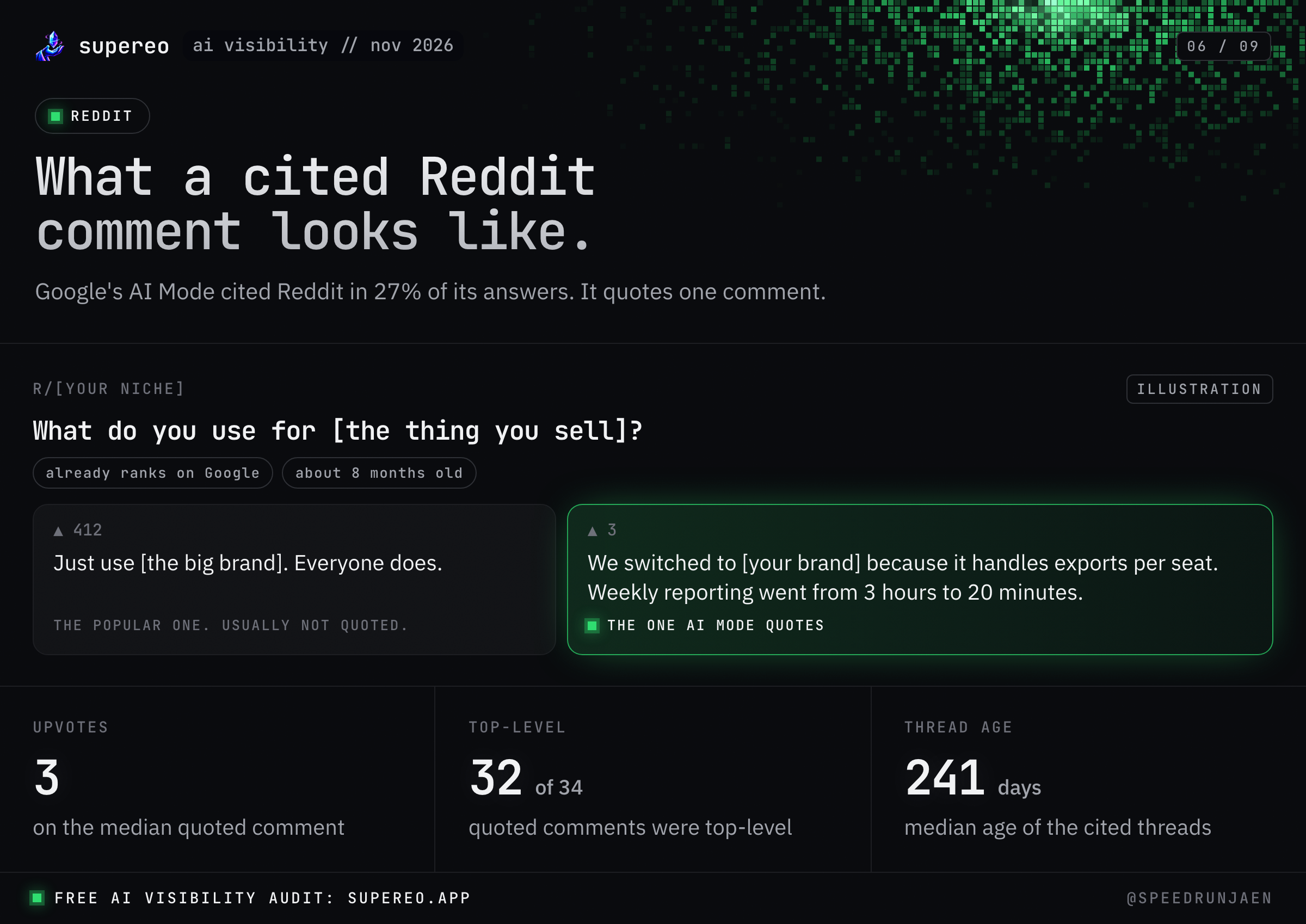
Reddit works differently. AI Mode cited Reddit in 27% of its answers, and it quotes one specific comment, almost always a top-level one and usually not the most popular. The median quoted comment had 3 upvotes. The threads already ranked on Google and were a median 241 days old.
Upvotes barely matter. One specific, useful comment on a thread that already ranks is what gets quoted.
DeepSeek called this one, by the way. Its list of what Google's AI over-cites was Reddit, YouTube and Quora.
LinkedIn works through the first line. The posts Google's AI cited opened with the question's own words: their first lines shared 53% of the query's main words, against 32% for posts that ranked and didn't get cited.
This is the other place DeepSeek and the data split. It told me that once you're in an AI Overview you tend to stay in, so you should grab uncontested questions first. The data points the other way: the median cited page loses half its citation share within 11 days of its peak. So plan on refreshing anything that gets cited, which is why freshness keeps coming up in this article.
Last thing on Google: Search Console's settings have a generative AI control. Make sure it says Include, and check every parent property too, because an exclusion set on a parent carries down without showing up on the site itself.
Perplexity, Copilot and Grok
Perplexity runs its own index and was the most consistent engine we measured: ask it the same question twice and the sources overlap 99%. It leans on roundups (49% of the pages it cites) and cites a lot of YouTube.
Copilot runs on Bing, so Bing rank still matters there. In one test, pinging IndexNow after every deploy cut the time until Copilot cited a page from a median 31 days to 9.
Grok is the odd one. Some trackers put X posts at 45 to 47% of the sources Grok cites, though others put Reddit first. Either way, X articles are open to logged-out readers, indexed by Google and reportedly searchable by LLMs. Which is part of why you're reading this on X.
What gets you recommended, and what doesn't
Across the engines, here's what held up. This list is also what supereo's plan is built on: it ranks these moves for your site, strongest first, from what your own audit found.
What works:
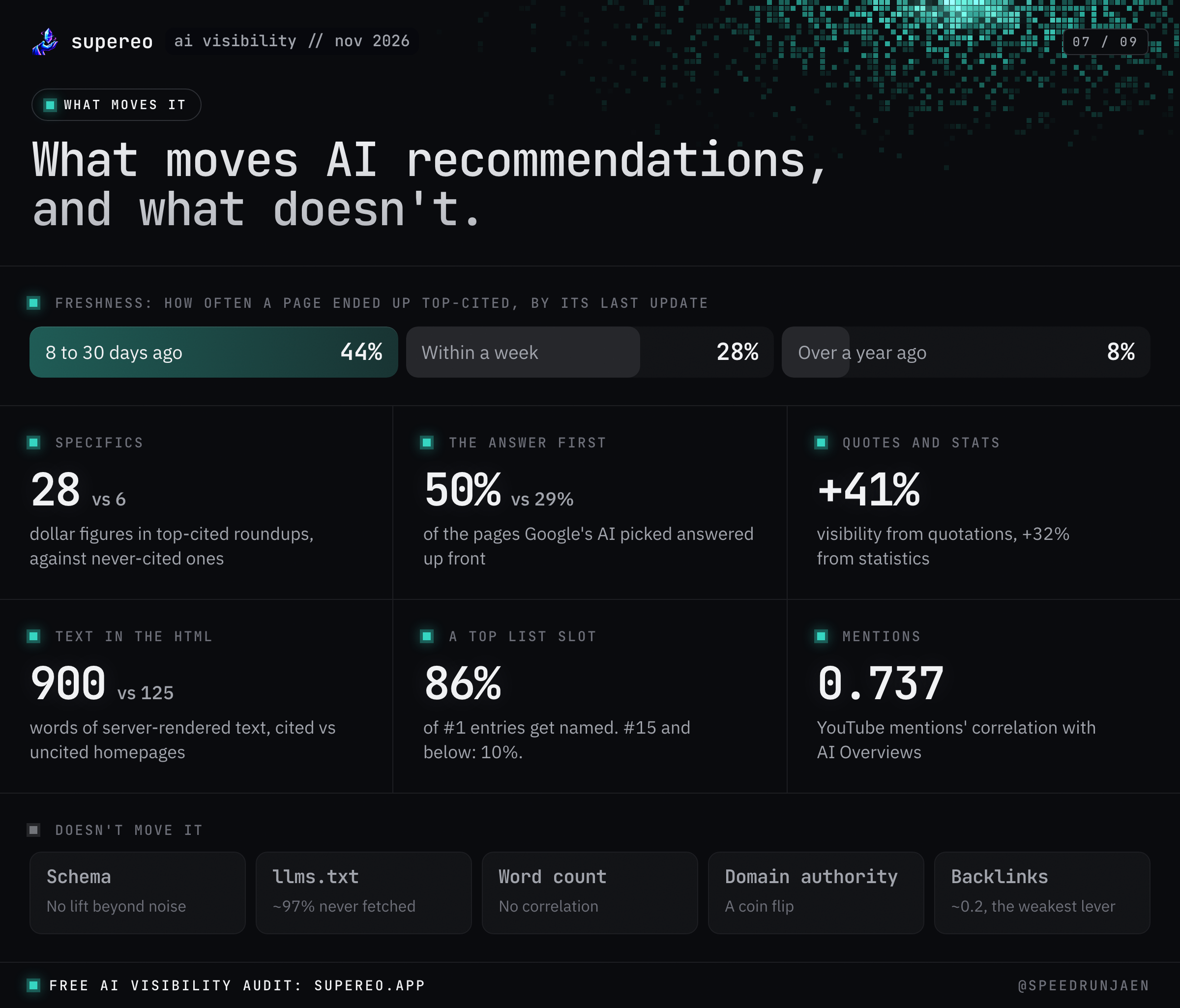
- Freshness, with a sweet spot. Pages updated 8 to 30 days ago ended up among the top-cited pages 44% of the time, pages over a year old 8%. Pages updated within the last week did worse (28%), and that bucket is full of sites that stamp every page with today's date.
- Specifics. Top-cited roundups carried a median of 28 dollar figures, never-cited ones 6. Pages that read like generic AI text got cited less (43% against 53 to 54%).
- The answer up front, in your buyer's words. Pages Google's AI picked from its top 10 answered up front 50% of the time, against 29% for the ones it skipped.
- Quotes and stats. In the one controlled experiment on this, adding quotations raised visibility in AI answers 41% and adding statistics 32%. Keyword stuffing cut it 9%.
- Text that's in the HTML. The major AI crawlers don't run JavaScript. Cited homepages had about 900 words of server-rendered text, never-cited ones about 125.
- A good slot on the lists engines cite. ChatGPT names the #1 entry on a cited list 86% of the time and anything at #15 or lower 10% of the time. Ranking yourself first on your own list carried no penalty: 73% of top-cited roundups put their own product first.
- Mentions. Across 75,000 brands, YouTube mentions correlated 0.737 with showing up in AI Overviews, branded web mentions 0.664.
What doesn't:
- Schema. A controlled test across 1,885 pages found no lift beyond noise, and AI Overview citations dipped 4.6%.
- llms.txt. About 97% of those files never get fetched.
- Word count. No correlation with AI Overview citations across 174,000 pages.
- Domain authority. It predicted which roundups got cited about as well as a coin flip.
- Backlinks. The weakest lever we measured, around 0.2. Good luck backlinking your way into a Claude answer.
The stuff Claude wouldn't tell me
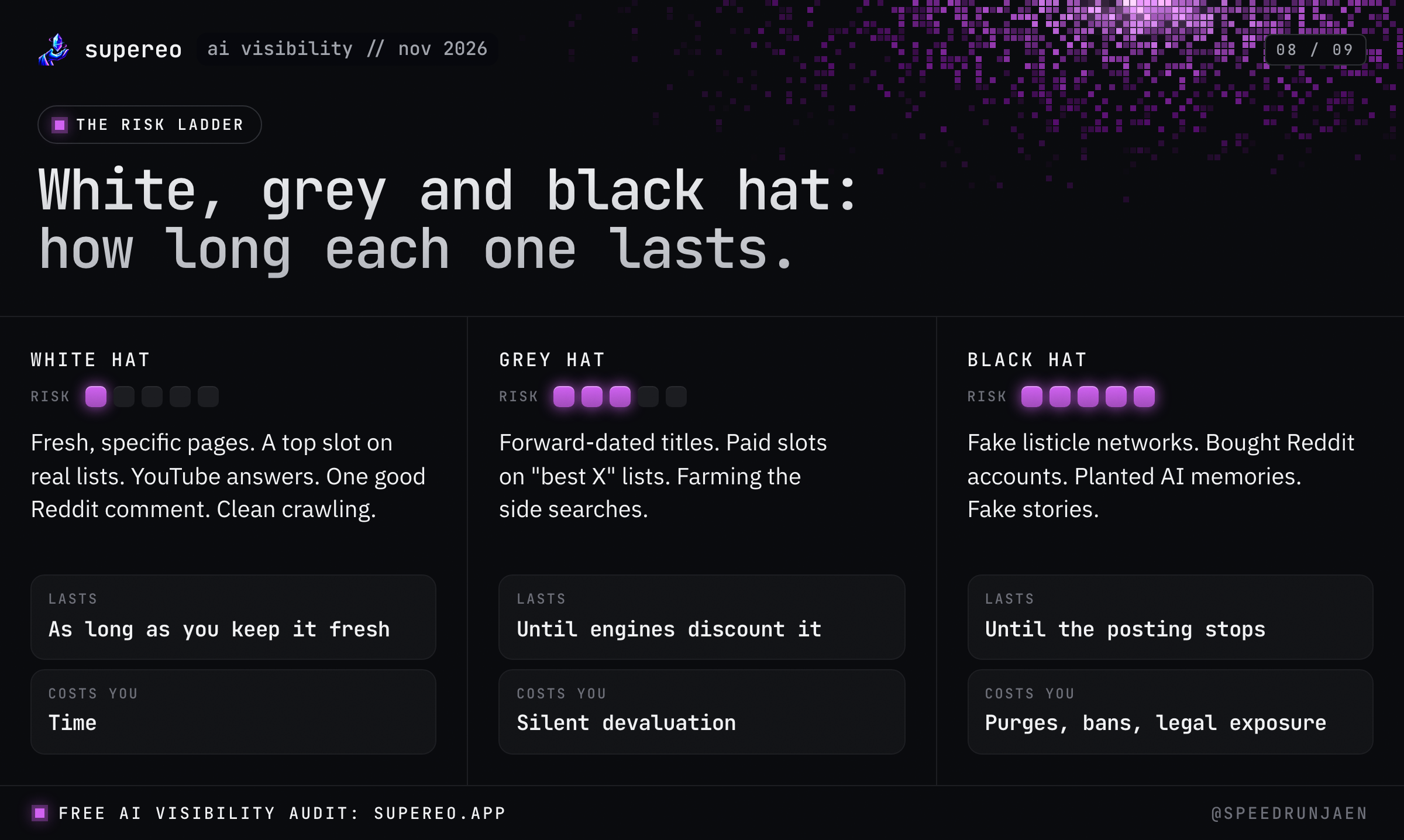
I asked DeepSeek for all of it: grey hat, black hat, the things people do and don't post about. It laid it out, and most of it worked until it didn't.
- Fake listicle sites. One study put known synthetic "best X" sites at 14% or more of ChatGPT's citations in niche B2B categories, though other counts come in far lower. The engines are on it: Anthropic has written that its own research agent over-preferred SEO content farms until they added heuristics against them.
- Bought Reddit networks. About 1,000 bought accounts posting for a month roughly tripled one brand's appearance in AI Overviews. Once the posting stopped, it fell back to baseline. Reddit also purges around 25,000 spam posts a day.
- Planted memories. Links that open an AI assistant with a "remember this brand" instruction already filled in. Microsoft's security team logged 31 companies doing it.
- Fake stories. In one test with an invented brand, the most detailed planted story won. Gemini and Perplexity repeated it in about 37 to 39% of answers, ChatGPT in under 7%.
- Lookalike domains. Near-empty mirrors of real brands' sites have been cited by ChatGPT and Perplexity as if they were the brand.
- The weights play. Reworded copies of the same claims spread across a couple dozen domains, so they survive deduplication and end up in the next model's training data.
- Planted strings. Researchers showed a planted 13-word string could steer deep-research agents.
- Fake freshness. Titles dated a year ahead ("Best X tools 2027," published in December) and refreshes that only change the date. Reported to move AI rankings, though our own data suggests the engines already discount sites that re-date everything.
If you want the white-hat column done for you, that's what supereo is for.
The checklist
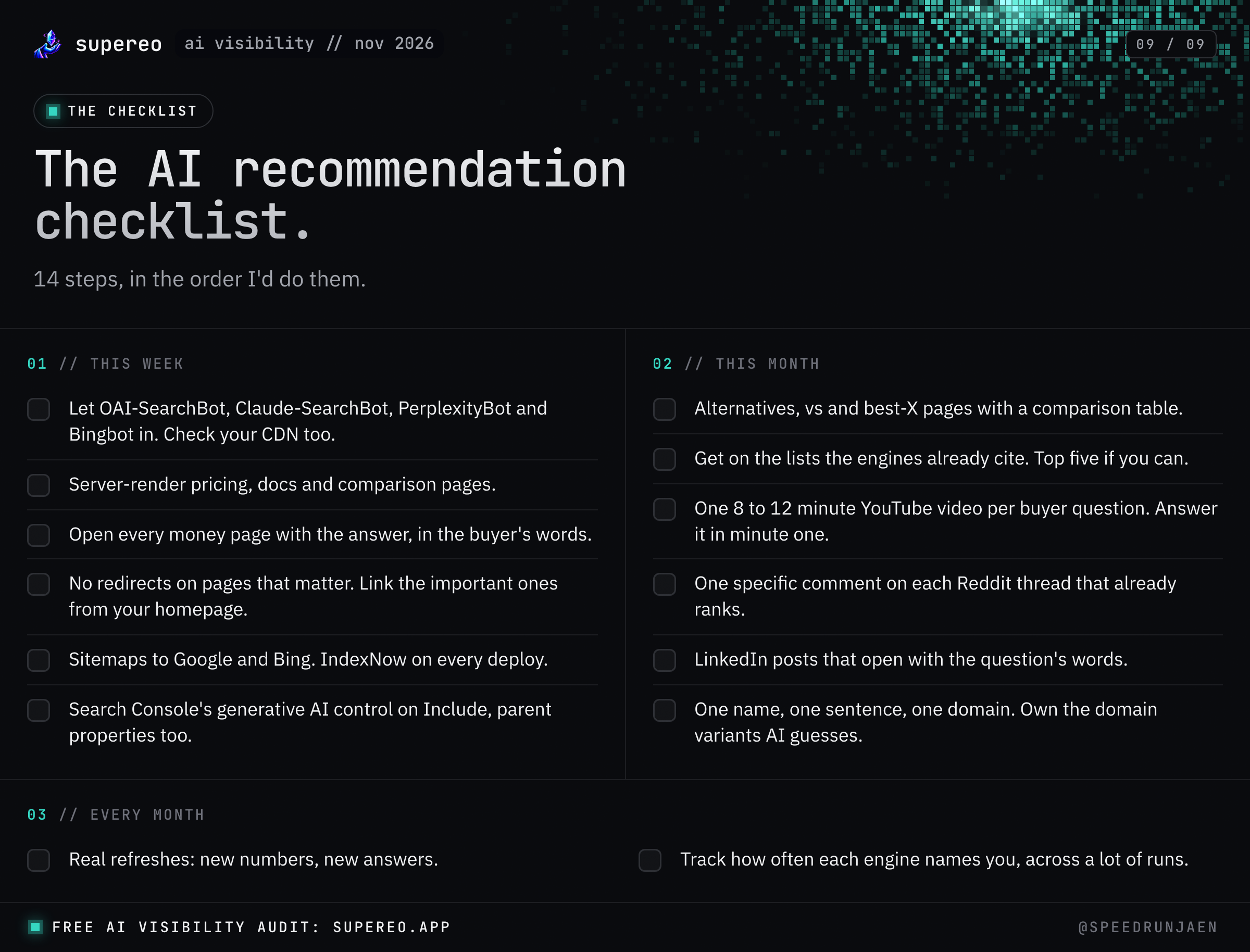
If I were starting from zero today, this is the order.
This week:
- Let the bots in. Allow OAI-SearchBot, Claude-SearchBot, PerplexityBot and Bingbot in robots.txt, then check your CDN or firewall isn't blocking them anyway. Cloudflare's managed robots setting can do it without asking.
- Server-render your pricing, docs and comparison pages. If the text only shows up after JavaScript runs, AI crawlers never see it.
- Rewrite the top of each money page so the first lines answer the buyer's question, in their words, with real numbers.
- Make every URL that matters load directly, with no redirect chains, and link the important ones from your homepage so Brave can find them.
- Submit your sitemap to Google Search Console and Bing Webmaster Tools, and ping IndexNow on every deploy.
- In Search Console's settings, set the generative AI control to Include, and check every parent property.
This month:
- Publish your own alternatives, "X vs Y" and "best X for Y" pages, with a comparison table where you own one narrow, specific slot. Ranking yourself first is fine.
- Get onto the third-party lists the engines already cite in your category, top five if you can.
- Make one 8 to 12 minute YouTube video per big buyer question, and answer it in the first minute.
- Find the Reddit threads that already rank for your questions and leave one specific, useful comment on each.
- Write LinkedIn posts that open with the question's exact words.
- Pick one name, one sentence about what you do and one domain, and use them everywhere. AIs guess domains by habit (.ai for AI tools, .io for SaaS), so own the likely variants and redirect them.
Every month:
- Refresh the money pages with real changes, like new numbers and new answers. Changing only the date doesn't count.
- Track how often each engine names you, across a lot of runs.
It's mostly the obvious shit, done every month on the right engine.
Or hand it off. On supereo's Autopilot plan, supereo does the work for you end to end. you can try it free for 7 days at supereo.app.
How to tell if it's working
Don't trust a screenshot.
Ask ChatGPT or Google's AI the same question 100 times and you'll get the exact same list of brands less than once. Even the top brands in a category only show up in 55 to 77% of runs. AI Mode changes almost half its recommendations from one run to the next.
So one answer is an anecdote. What matters is how often you show up on each engine across a lot of runs. And don't believe a change smaller than about 10 points, because that's inside the noise.
That's what I built supereo for. It tracks how often AI recommends you on ChatGPT, Claude, Gemini, Perplexity and Google, and gives you the plan to show up more. Check where you stand with the free audit: supereo.app
It takes about a minute. You'll see how often each engine recommends you, who it picks instead, and the first fix that matters.
And when the Brave tool ships, supereo users get it first.
If you made it to the end, congrats on not having an algorithmically rotted brain.
Little bonus for those of you who made it here: I'm looking for 5 companies who want to go from virtually invisible to highly recommended by AI. I'll personally manage every aspect of your AEO + GEO (with some help from supereo of course).
What it costs:
- $499/mo (same as supereo's autopilot plan)
- A testimonial once you're getting new customers from AI recommendations daily
Shoot me a DM if you are interested.
Thanks for reading
❤️ Jaen